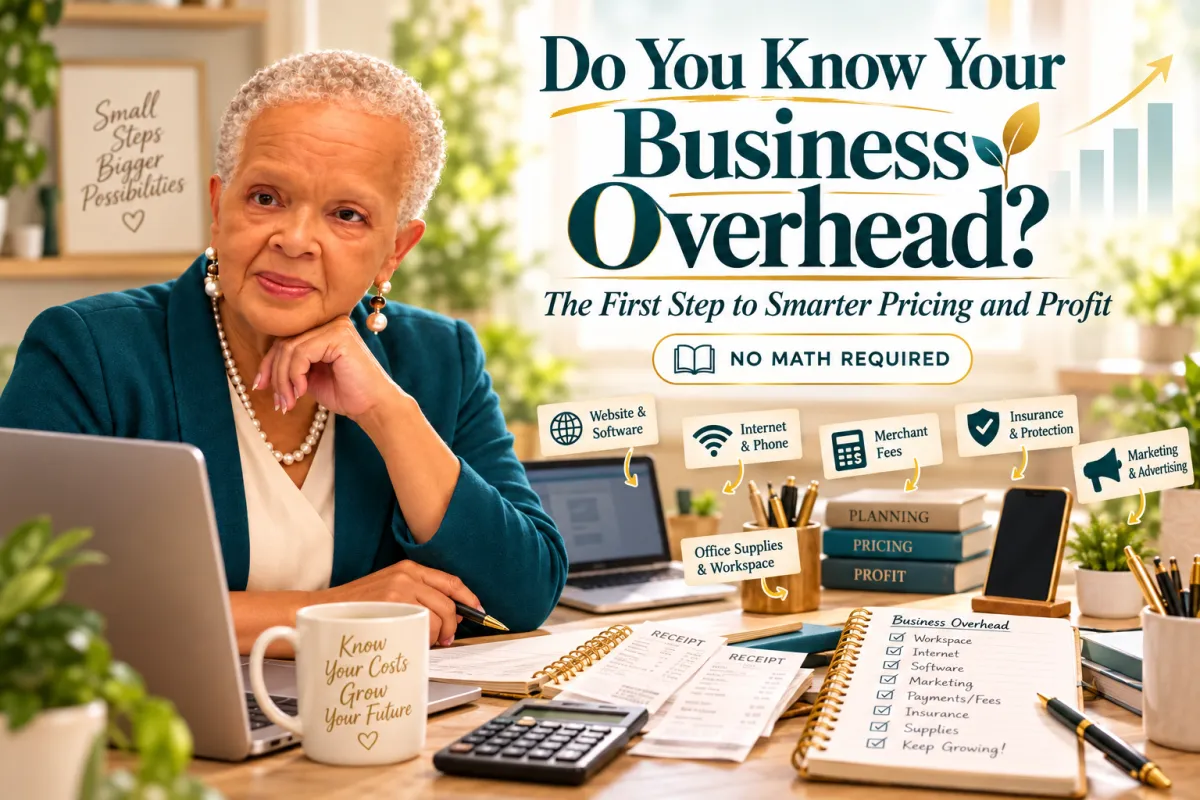
Do You Know Your Business Overhead?
Do You Know Your Business Overhead?
You know what you sell.
You may know what you paid for your product.
You may even know how much money came into your business last month.
But do you know what it costs to keep your business in business?
That is a different question.
And it is one that many home-based business owners, solopreneurs, side-hustlers, and newly self-employed entrepreneurs have never been taught to answer.
In the first two stories, I shared how BOIT began and how one small worksheet grew into a much larger financial-learning system.
But underneath all of that growth was one simple problem:
Many business owners do not clearly know their overhead.
And if you do not know your overhead, you are missing an important part of the financial picture.
What Is Business Overhead?
Business overhead includes the operating expenses required to keep your business functioning.
These are not always the direct costs of making the product or delivering the service.
They are the costs of keeping the business alive.
Think about things like:
Internet.
Telephone.
Website expenses.
Software subscriptions.
Insurance.
Professional services.
Bank fees.
Merchant processing fees.
Advertising.
Licenses.
Office supplies.
Equipment.
Home office expenses.
And other costs connected to operating the business.
Some of these expenses may feel small.
Some may already exist in your household.
Some may be automatic charges you barely notice anymore.
But they are still part of the cost of doing business.
The Expense Does Not Disappear Because You Did Not Count It
That is one of the most important lessons I want business owners to understand.
If you forget to include an expense, that expense does not disappear.
The internet company still wants to be paid.
The software subscription still renews.
The merchant processor still takes its fee.
The insurance premium still comes due.
The business still consumes resources.
Someone still pays.
And too often, that someone is the owner.
That is where the confusion starts.
A business owner may look at the money coming in and think:
“I made a profit.”
But some of that money may already be committed to expenses that were never identified.
That is how someone can be making sales and still asking:
“Where is my money?”
Sometimes the money is not missing.
It already had somewhere to go.
Direct Costs Are Not the Whole Story
This is especially important for people who sell products.
You may know what you paid for the product.
You may know the packaging cost.
You may know the shipping cost.
You may know the ingredients.
Those are important.
But that is not the complete cost of operating the business.
The business itself has expenses.
And those expenses must eventually be supported by the revenue the business generates.
The same applies to service businesses.
You may think:
“I do not have inventory, so my costs are low.”
Maybe.
But you may still have software.
Phone.
Internet.
Advertising.
Insurance.
Website expenses.
Subscriptions.
Professional services.
Payment-processing fees.
And your workspace.
The business has a cost before you ever begin talking seriously about profit.
What About the Home-Based Business Owner?
This is where things become especially important.
Many home-based entrepreneurs use resources that already existed before the business began.
The internet was already there.
The phone was already there.
The home was already there.
The utilities were already being paid.
So it can be easy to think:
“That is not really a business expense.”
But if the business is using part of those resources, there may be a legitimate business-use portion that needs to be identified and handled appropriately.
That does not mean every household expense suddenly becomes a business expense.
It means the business owner needs to understand what belongs to the business and what does not.
That distinction matters.
Why Overhead Matters to Pricing
Here is where overhead connects directly to pricing.
Suppose you know your product costs.
Suppose you know your packaging.
Suppose you know your commission or transaction fees.
But you do not know your business overhead.
Then your price may appear profitable while still failing to carry the cost of keeping the business operating.
That is why I say:
Before we can price intelligently, we need to understand what the business is carrying.
This is also why BOIT came before the full use of MyPriceIsRight™.
MyPriceIsRight™ asks:
What must this price accomplish?
BOIT asks:
What costs must this business carry?
Those two questions belong together.
What Should You Know?
At minimum, every business owner should be able to answer:
What are my recurring business expenses?
What expenses happen monthly?
Quarterly?
Annually?
Which costs are direct?
Which costs are part of overhead?
Which expenses are shared between personal and business use?
How much does it actually cost to keep this business operating?
And once those numbers are identified:
What are they telling me?
That is where the real financial learning begins.
You Do Not Need to Become a Bookkeeper
You do not need to become a professional bookkeeper.
You do not need to love math.
You do not need to sit with a calculator trying to convert every annual or quarterly expense into a monthly amount.
Technology can help with the arithmetic.
Your job is to learn how to recognize the expense and understand what it means.
That is why BOIT was built around a simple principle:
NO MATH REQUIRED.
The goal is not to turn you into an accountant.
The goal is to help you become a better-informed business owner.
Because when you understand your numbers, you can make stronger decisions.
Pricing decisions.
Spending decisions.
Profit decisions.
Growth decisions.
And sometimes survival decisions.
So Let Me Ask You Again
Do you know your business overhead?
Not approximately.
Not what you think it might be.
Not what you remember paying last month.
Do you know what it really costs to keep your business in business?
If the answer is no, that is not the end of the conversation.
That is where the learning begins.
And that is exactly why BOIT exists.
Ready to Take a Closer Look?
Meet BOIT — the Business Overhead Identification Tool.
NO MATH REQUIRED.
BOIT was designed to help entrepreneurs identify the expenses involved in operating their businesses and begin understanding what those numbers mean.
For its introductory launch, BOIT is available for $37 for 144 hours — six days.
Why 144 hours?
Six days × 24 hours = 144 hours.
Genesis describes six days of creation followed by rest on the seventh. We are using those six days as a meaningful launch window for one of several financial-learning tools designed to help today’s entrepreneur move toward greater financial understanding and economic self-sufficiency.
Explore BOIT:
https://overhead.hbtaxsavings.com/#order
LET’S BUILD TOGETHER.